Read time: 5 minutes
If you have spent time exploring private investment opportunities in the UK, you will almost certainly have encountered the term "loan note." It appears in information documents, in term sheets, and in conversations with introducers and advisers. Yet for many investors, including those who have built considerable wealth through their careers and business activities, it remains a phrase that is nodded at rather than fully understood.
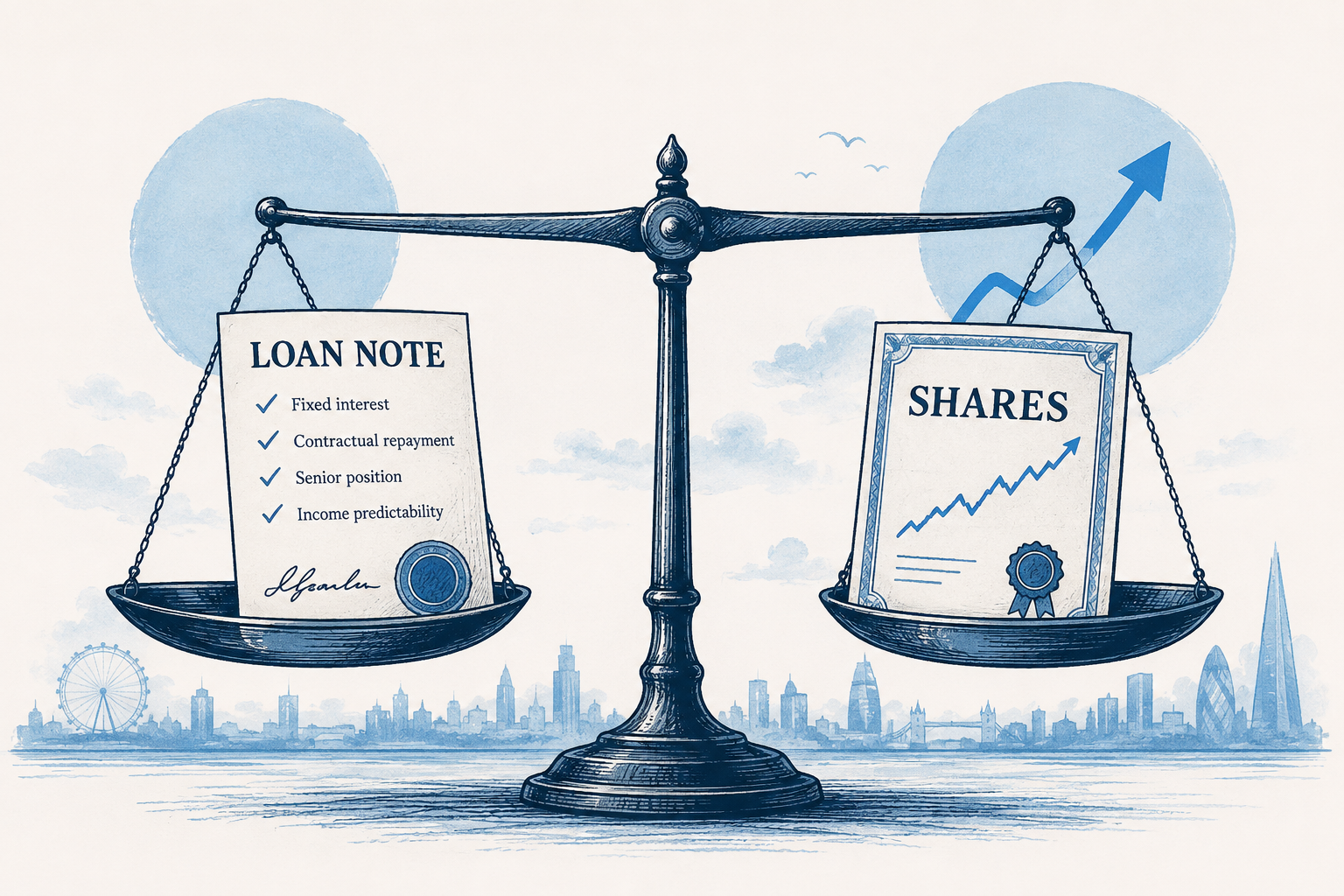
That is worth addressing. Because the distinction between a loan note and a share is not a technical footnote. It is one of the most fundamental differences in the structure of an investment, and it has real consequences for how you are treated as an investor, what return you can expect, and what happens to your capital if things do not go to plan.
At Oros Consultancy, we believe that clarity is the foundation of good investment decisions. So here is a plain English explanation of what a loan note is, how it differs from equity, and what each structure means for you in practice.
Starting with the basics: debt versus equity
Every investment in a private company falls into one of two broad categories: debt or equity.
When you buy shares in a company, whether a publicly listed business or a private one, you are buying equity. You become a part-owner of that business. Your financial fate is tied directly to its performance. If the company grows and becomes more valuable, your shares are worth more. If it struggles, your shares lose value. If it fails entirely, shareholders are typically last in the queue when whatever remains is distributed. Equity can generate significant returns, but it carries the full risk of ownership.
When you invest via a loan note, you are doing something fundamentally different. You are lending money to the company under a formal legal agreement. The company promises to pay you interest over an agreed period and to repay your principal, the original sum you invested, at a specified future date. You are not a part-owner of the business. You are a creditor.
This distinction matters enormously, and it shapes almost everything about how the two types of investment behave.
What a loan note actually looks like
A loan note is, at its core, a legal contract. It sets out the amount being lent, the interest rate the company will pay, the schedule on which interest will be paid, the date on which the principal will be repaid, and the conditions under which the agreement can be varied or terminated.
The interest rate on a loan note is fixed at the outset. Unlike a dividend, which a company can reduce or cancel entirely if its profits fall, the interest on a loan note is a contractual obligation. The company is legally required to pay it on the agreed terms. This gives loan note investors a degree of income predictability that equity investors simply do not have.
Loan notes can be structured in various ways. Some pay interest monthly or quarterly throughout the term. Others roll up the interest and pay it, along with the principal, at the end of the agreed period. Some loan notes are secured against specific assets, meaning that if the company defaults, the creditor has a legal claim over those assets. Others are unsecured. The precise terms vary from one opportunity to the next, and understanding them fully before committing capital is essential.
Where do loan note holders sit if something goes wrong?
This is perhaps the most important practical difference between loan notes and equity, and it is the question that investors most often fail to ask before they invest.
When a company encounters serious financial difficulty, not all investors are treated equally. There is a legally defined order, known as the capital structure or repayment hierarchy, in which different types of claimant are paid. Secured creditors, whose debt is backed by specific assets, sit at the top. Unsecured creditors, including most loan note holders, sit below them but still above equity holders. Shareholders, those who own equity in the business, are last.
In practice, this means that in a worst-case scenario where a company is wound up and its assets are distributed, equity holders often receive little or nothing once creditors have been satisfied. Loan note holders, sitting higher in the structure, have a meaningfully better chance of recovering some or all of their capital, though this is never guaranteed and the risk of loss remains real.
This is not a reason to automatically prefer loan notes over equity in every situation. Each structure involves trade-offs, and the right choice depends on your objectives, your risk tolerance, and the specific terms on offer. But it is a reason to understand clearly where you sit in the hierarchy before you commit.
The trade-off: income and seniority versus upside participation
If loan notes offer greater income predictability and a more senior position in the repayment hierarchy, why would anyone choose to invest in equity instead?
The answer is upside.
A loan note investor's return is defined at the outset. They will receive their agreed interest and, if all goes well, their principal back at maturity. They will not participate in the growth of the business beyond that. If the company they have lent money to goes on to become extremely valuable, if it is acquired at a significant premium or lists on a stock exchange at a strong valuation, the loan note investor does not share in that upside. Their return is fixed.
An equity investor, by contrast, participates fully in any increase in the value of the business. If the company grows significantly in value between the point of investment and the point of exit, the equity investor's stake grows with it. The potential returns can be considerably higher than those available through a loan note. So can the losses.
Some investment structures attempt to combine elements of both. Convertible loan notes, for example, begin as debt instruments but can convert into equity under certain conditions, allowing investors to participate in upside whilst retaining some of the protections of a creditor position in the earlier stages of the investment.
Choosing the right structure for your circumstances
There is no universally correct answer to the question of whether a loan note or an equity investment is more appropriate. The right choice depends on what you are trying to achieve, how much risk you are comfortable carrying, what your existing portfolio looks like, and how you would be affected if the investment did not perform as expected.
What matters is that you understand the distinction clearly before you proceed, and that you are not choosing one structure over another simply because it was the one presented to you, or because you did not feel comfortable asking for an explanation.
At Oros Consultancy, we are always happy to walk through the structure of any opportunity we introduce in as much detail as you need. If you would like to explore the types of investment we currently work with, or simply to understand more about how different investment structures work in practice, contact our team for a no-obligation conversation.
Your capital is at risk. You may lose all the money you invest. This article does not constitute financial advice and should not be relied upon as such. These investments are intended for Certified High Net Worth Individuals and Self-Certified Sophisticated Investors as defined under the Financial Services and Markets Act 2000 (Financial Promotion) Order 2005. If you are in any doubt as to whether this investment is appropriate for you, please seek independent financial advice from a person authorised by the Financial Conduct Authority.