Read time: 5 minutes
If you have spent any time reading investment literature, you will have seen the phrase so many times that it has almost certainly stopped registering. Capital at risk. It appears at the foot of every document, every article, every communication from every investment firm in the country. It is so ubiquitous that most people read straight past it.
That is understandable. But it is also a mistake. Because "capital at risk" is not a legal formality inserted by compliance teams to satisfy a regulatory checkbox. It is a genuine and important statement about the nature of what you are doing when you invest money — and understanding what it actually means, in practical terms, makes you a considerably better investor.
At Oros Consultancy, we are direct with every investor we work with about what this phrase means and what it does not mean. This article sets out both.
What it literally means
When an investment document states that your capital is at risk, it is telling you that the money you invest may not all come back to you. In the worst case, you may lose every pound you put in.
This is not a theoretical possibility included for legal completeness. It is a real outcome that occurs in some private investments. Businesses fail. Markets turn. Assumptions built into an investment thesis prove incorrect. When things go wrong in a private company, investors can find themselves receiving back less than they invested — sometimes significantly less, and sometimes nothing at all.
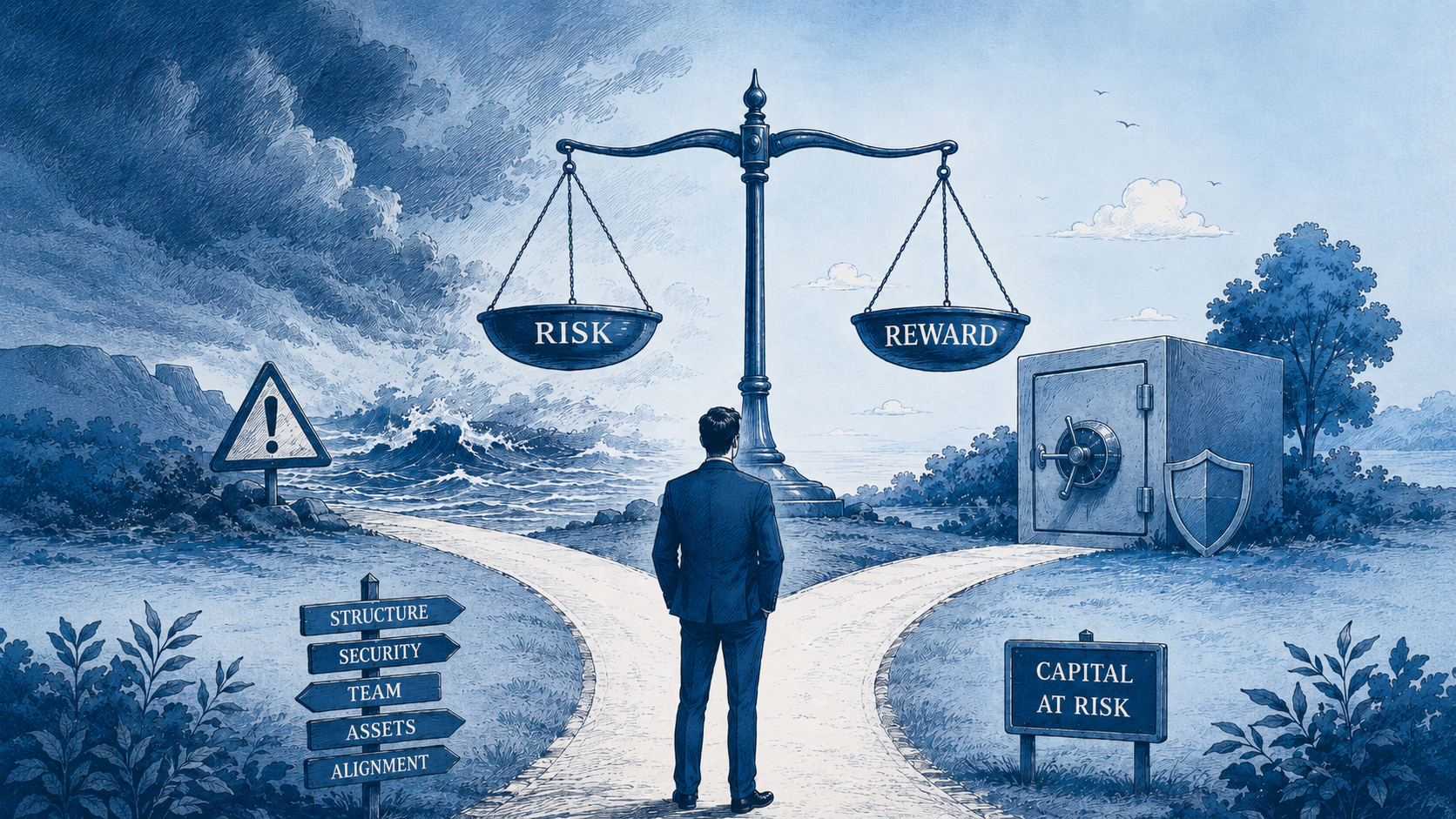
This is the central and irreducible truth of investment risk. No return is guaranteed. No capital is safe in the absolute sense. The question is not whether risk exists — it always does — but what kind of risk you are taking, how it has been structured and mitigated, and whether it is appropriate for your circumstances.
What it does not mean
Acknowledging that capital is at risk does not mean that every investment is equally risky, or that the probability of loss is the same across all structures and opportunities.
Different investments carry very different risk profiles. A secured loan note, where the investor's debt is backed by specific assets that can be recovered in the event of default, carries a different risk profile from an unsecured equity stake in an early-stage business with no revenue. Both carry risk. Both could result in loss. But the nature, the severity, and the probability of that loss are materially different.
Similarly, the way an investment is structured — who sits ahead of you in the repayment hierarchy, what assets underpin the investment, how diversified the underlying business is, how experienced the management team is — all affect the real-world risk profile of the investment, even though none of these factors changes the fundamental truth that capital is at risk.
Understanding the difference between the legal statement that capital is at risk and the actual risk profile of a specific, well-structured investment opportunity is one of the most important skills any private investor can develop.
How professional investors think about risk
Most people, when they encounter the phrase "capital at risk," instinctively think about it in binary terms. Either they lose money or they do not. Either the investment works or it does not.
Professional investors think about risk differently. They think about it in terms of probability and magnitude — how likely is a loss, and how large could that loss be? They think about it in terms of the range of possible outcomes, not just the worst case. And they think about it in terms of how a potential loss would affect their overall financial position, not just their investment portfolio in isolation.
This last point is particularly important. A loss of £50,000 means something very different to an investor with £5 million in assets and no immediate need for that capital than it does to an investor for whom £50,000 represents a significant proportion of their total wealth. The investment carries the same risk in both cases. The impact of that risk on the two investors is entirely different.
This is why the eligibility criteria for private investment — the Certified High Net Worth Individual and Self-Certified Sophisticated Investor categories established under the Financial Services and Markets Act 2000 — exist. They are not a guarantee that qualifying investors will make good decisions. They are a reasonable proxy for the financial resilience required to absorb potential losses without catastrophic consequences.
The difference between risk and uncertainty
There is a distinction worth drawing between risk and uncertainty, because the two words are often used interchangeably when they describe quite different things.
Risk, in the investment sense, refers to outcomes that can be assessed and, to some degree, quantified. The risk that a borrower defaults on a loan note can be evaluated by looking at the quality of the underlying business, the experience of the management team, the security backing the investment, and the terms of the agreement. It cannot be reduced to zero, but it can be understood and managed.
Uncertainty refers to outcomes that are genuinely unknowable in advance — macro events, regulatory changes, geopolitical shocks — that no amount of analysis can fully account for. All investments carry some degree of uncertainty. The best-structured investments minimise the degree to which their outcome depends on uncertain external factors, and maximise the degree to which it depends on things that can be assessed, managed, and influenced.
When evaluating any private investment opportunity, it is worth asking: how much of the investment thesis depends on things the management team can control, and how much depends on things they cannot? The more the outcome rests on the quality of execution by a capable team in a structurally sound market, the more the risk is genuine risk rather than pure uncertainty.
Practical questions to ask about any investment
Rather than treating "capital at risk" as a disclaimer to be absorbed and forgotten, treat it as an invitation to ask better questions about any specific opportunity. Here are the most useful ones.
What is the worst realistic outcome, and what would it mean for me personally? Not the theoretical absolute worst case, but the realistic downside based on the investment structure, the market, and the track record of the team involved.
Where do I sit in the repayment hierarchy? If the business encounters difficulty, am I a secured creditor, an unsecured creditor, or an equity holder? Each position carries a meaningfully different expected recovery in a stress scenario.
What assets underpin this investment? Is there something tangible — physical assets, established cash flows, contracted revenue — that provides a floor beneath the investment, or is the value entirely dependent on future performance?
How has the management team handled adversity before? A team that has navigated a business through difficulty and protected investor capital in the process is a different proposition from one that has only operated in favourable conditions.
Is this capital I can genuinely afford to lose? Not afford to lose comfortably, but afford to lose without it materially affecting my financial security or standard of living. If the honest answer is no, that is the most important piece of information in the entire assessment.
A final thought
The investors who navigate private markets most successfully are not those who ignore risk or those who are paralysed by it. They are those who understand it clearly, ask the right questions about it, and make deliberate decisions about how much of it they are willing to accept in exchange for the returns on offer.
"Capital at risk" is not a reason to avoid private investment. It is a prompt to engage with it seriously, with clear eyes and the right questions prepared.
At Oros Consultancy, we present every investment opportunity with full transparency about its risk profile, its structure, and the realistic range of outcomes. If you would like to explore the opportunities we currently work with, and to understand the risk profile of each in detail, contact our team for a no-obligation conversation.
Your capital is at risk. You may lose all the money you invest. Returns are not guaranteed and past performance is not a reliable indicator of future results. This article does not constitute financial advice and should not be relied upon as such. These investments are intended for Certified High Net Worth Individuals and Self-Certified Sophisticated Investors as defined under the Financial Services and Markets Act 2000 (Financial Promotion) Order 2005. If you are in any doubt as to whether this investment is appropriate for you, please seek independent financial advice from a person authorised by the Financial Conduct Authority.