Read time: 5 minutes
There are a handful of terms that appear in almost every private investment document and are almost never properly explained. EBITDA is perhaps the most common of them. It sits in information memoranda, pitch decks, and investor updates as though its meaning is self-evident — and for most investors, it is not.
That matters. Because EBITDA is not just a piece of financial jargon. It is the single most widely used measure for valuing private businesses, and understanding what it means — and why investors use it rather than simpler measures — is essential for anyone considering a private market investment.
At Oros Consultancy, we believe that investors who understand the language of private investment make better decisions. So here is a plain English explanation of what EBITDA is, why it is used, and what it means in practice when someone talks about buying a business at a multiple of EBITDA.
What EBITDA stands for
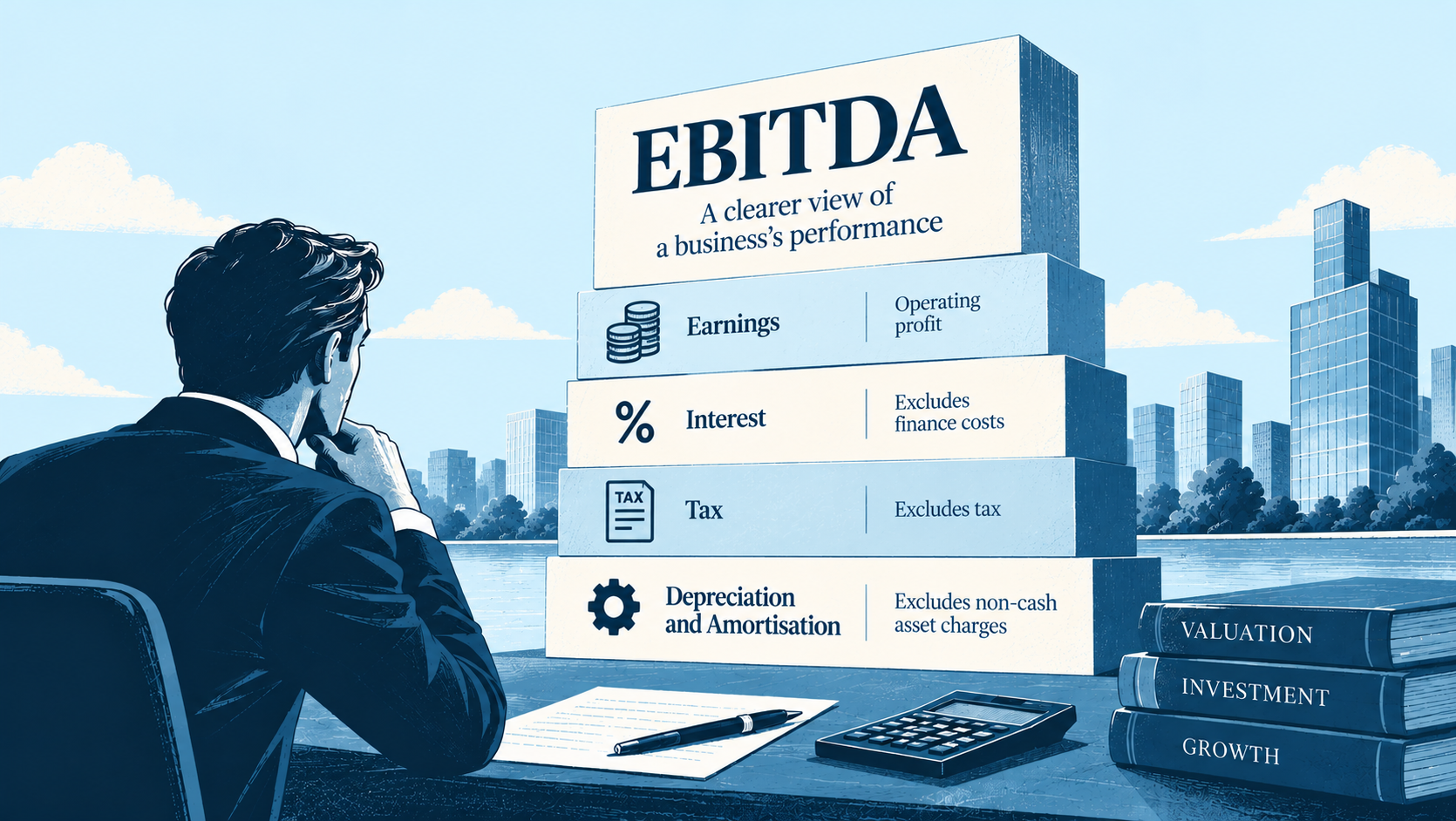
EBITDA stands for Earnings Before Interest, Tax, Depreciation, and Amortisation. Each of those words represents something that has been stripped out of the profit figure before the calculation is made. To understand why, it helps to work through each element briefly.
Earnings is simply profit — the revenue a business generates minus its costs.
Interest refers to the cost of any debt the business carries. If a business has borrowed money, it pays interest on that debt, which reduces its reported profit. EBITDA strips out this interest cost because the level of debt a business carries is often a function of how it is financed rather than how well it operates. Two identical businesses with different financing structures will show different profit figures — but their underlying operational performance is the same.
Tax works similarly. The amount of tax a business pays depends on its legal structure, its jurisdiction, and various reliefs and allowances that may or may not apply. Stripping out tax allows businesses to be compared on an operational basis without tax differences distorting the picture.
Depreciation and amortisation are accounting charges that spread the cost of long-term assets — machinery, vehicles, intangible assets — over their useful life. A business that bought a fleet of vehicles three years ago will be showing a depreciation charge on its accounts even though it has not spent that money this year. Stripping these charges out gives a cleaner picture of the actual cash the business generates from its operations.
Why EBITDA rather than profit?
The reason investors use EBITDA rather than headline profit to value private businesses comes down to one word: comparability.
If you are trying to compare two businesses — or assess whether a business is being sold at a fair price — you want a measure that reflects the underlying operational performance of the business rather than the specific way it happens to be financed, taxed, or accounted for. EBITDA provides that. It is an approximation of the cash a business generates from its core operations, before the effects of financing decisions and accounting conventions distort the picture.
It is not a perfect measure — no single number ever is — but it is the most widely used and most consistently applied benchmark for valuing private businesses, which means it allows meaningful comparisons across different opportunities in different sectors.
What a multiple of EBITDA means
Once you understand what EBITDA is, the concept of a valuation multiple becomes straightforward.
If a business generates £500,000 in EBITDA and is valued at £2.5 million, it has been valued at a multiple of 5 times EBITDA — written as 5x EBITDA. If the same business were valued at £4 million, that would be 8x EBITDA.
The multiple reflects how attractive, stable, and scalable the market believes the business to be. A small, single-site business with one key employee and no management structure beneath them might trade at 4x or 5x EBITDA. A large, professionally managed group operating across dozens of locations with diversified revenue, experienced leadership, and a clear growth trajectory might trade at 10x, 12x, or higher.
This difference in valuation multiples between small businesses and large groups is the foundation of the multiple arbitrage strategy that underpins many buy-and-build investment opportunities — a concept we have explored in more detail in a separate article on our website.
What affects the multiple a business commands?
Several factors influence whether a business trades at a high or low multiple of EBITDA, and understanding them helps investors assess whether a particular acquisition price is sensible.
The stability and predictability of the revenue is one of the most important. A business with contracted, recurring revenue that does not depend on winning new customers every month will command a higher multiple than one where revenue is volatile or one-off. Buyers pay a premium for predictability.
The quality of the management team matters significantly. A business that is entirely dependent on its founder to function is worth less than one with a professional management layer that can operate and grow the business independently. The former is a job as much as it is a business. The latter is a genuine institutional asset.
The size and diversification of the business affects the multiple. Larger businesses with multiple revenue streams and no single point of failure are less risky and therefore more valuable relative to their profit than smaller, more concentrated ones.
The sector also matters. Businesses in essential services, with non-discretionary demand and high barriers to entry, command higher multiples than those in cyclical or competitive markets where revenue is more vulnerable.
Why this matters for private investors
For investors considering a private market opportunity built on an acquisition strategy, understanding EBITDA and valuation multiples is not an academic exercise. It is the foundation for assessing whether the investment thesis makes sense.
Is the business being acquired at a sensible entry multiple? Is the exit multiple target realistic given the size, quality, and sector of the group being built? How much of the projected return depends on multiple expansion, and how much depends on genuine improvement in EBITDA? These are the questions that separate a well-constructed investment thesis from one that relies on optimistic assumptions.
At Oros Consultancy, we are always happy to walk investors through the financial mechanics of any opportunity we present in as much detail as they need. If you would like to understand more, contact our team for a no-obligation conversation.
Your capital is at risk. You may lose all the money you invest. This article does not constitute financial advice and should not be relied upon as such. These investments are intended for Certified High Net Worth Individuals and Self-Certified Sophisticated Investors as defined under the Financial Services and Markets Act 2000 (Financial Promotion) Order 2005. If you are in any doubt as to whether this investment is appropriate for you, please seek independent financial advice from a person authorised by the Financial Conduct Authority.